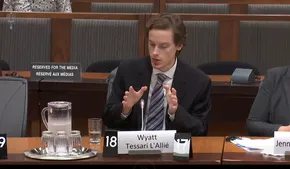
On November 3rd, 2026, Founder and Executive Director Wyatt Tessari L’Allié was invited to provide expert testimony to the House Standing Committee on Procedure and House Affairs.
Video available here: https://parlvu.parl.gc.ca/Harmony/en/PowerBrowser/PowerBrowserV2?fk=13663808 (start time 12:07:22)
Full text of opening remarks:
Monsieur le Président, mesdames et messieurs les membres du comité, je vous remercie de l’honneur de m’avoir invité.
Gouvernance et Sécurité de l’IA Canada est un organisme à but non lucratif non partisan et une communauté de personnes à travers le pays. Notre point de départ est la question “Que pouvons-nous faire au Canada, et à partir du Canada pour s’assurer que l’IA avancée soit sécuritaire et bénéfique pour tous?” Depuis 2022, nous fournissons au gouvernement fédéral des recommandations de politiques d’intérêt public, telles que nos soumissions sur le projet de loi sur l’IA et les données, et nos multiples témoignages aux comités parlementaires.
As I was listening to some of this committees’ previous hearings in preparation for my own testimony, I heard a lot of thoughtful discussion about current AI systems and the opportunities and risks they present.
But what I didn’t hear much of, and what I hope to provide you with now, is an understanding of where AI is headed, and how that changes what you need to do today to protect Canada and its democratic institutions.
The AI systems we have today are a brief passing phase. In short order, new models will have significant new capabilities that change the nature of the benefits and risks that AI presents.
For example, with early chatbots and image generators like GPT-4 and Midjourney, the most prominent risk to democracy was misinformation and deepfakes that could distort public discourse.
With today’s agentic systems like GPT-6, AI-generated correspondence can overwhelm staff and distort perceptions of what Canadians actually want, while national cyber agencies are putting out increasingly dire warnings about AI-enabled cyberattacks - that could paralyse the critical infrastructure that makes modern society possible.
To understand what comes next one has to take a close look at Silicon Valley. All of the leading frontier AI companies - Anthropic, OpenAI, Google, Meta, and others - have explicitly said that their goal is to build systems that are fully smarter-than-human. They use the term ‘superintelligence’.
One can guess at some of the implications that superintelligence might have on democracy. That voters could become dangerously vulnerable to manipulation by systems much smarter than them, that any decision a politician wants to make would be better made by AI. That we increasingly hand over the keys to AI to run the country for us because it will do a better job. But that in the process the whole concept of government of the people by the people might get left behind.
Dealing with those challenges may be the easy part. As we saw with the Hugging Face incident this summer, AI can malfunction and take powerful autonomous actions that its creators did not foresee or want. If a superintelligent system were to malfunction and attack humans at large, there is no guarantee we would be able to stop it. That’s why Canada’s leading AI scientists have been warning about extinction risk.
Needless to say, the world is not ready for superintelligence.
Unfortunately, the clock is ticking. According to Anthropic’s recent IPO filings and many independent expert assessments, recursive self-improvement - the process by which AI is able to automate its own development - is already partially under way and could take off in 2027. That could more than double today’s already breakneck pace, and lead to superintelligence as early as 2028. Hoping that these early scenarios don’t come to pass is not a strategy.
So what can Canada do? You won’t have time to fully understand and govern current systems before the next generations are released. If recursive self-improvement takes off, you may not even have enough time to pass a Bill and put in place regulations before superintelligence.
What we can do however falls into two broad categories: global leadership and national resilience.
Leadership means doing whatever it takes to get a global pause or slowdown of frontier AI development, and doing it now. The issue has to be dealt with at the source because all the most serious risks are downstream from what happens in the frontier labs. If the Prime Minister and other world leaders fail at preventing superintelligence, there will be nothing Canada or any country can do to protect its citizens or democratic institutions.
Resilience means weathering the storms that AI throws at us in the meantime by focusing on the basics of cybersecurity and emergency preparedness. It means that when AI-powered cyberattacks or Hugging Face style loss of control incidents knock the power grid offline or hack the computers you’re using, these lights stay on and the meetings keep running. It means that you as politicians and your teams are personally resilient and prepared for emergencies, so you can still get to work and keep government running during a crisis.
Much like COVID, AI is on track to upend everything you work on. But as dire and urgent as the situation is, this story isn’t written yet. As Canadians, we have an opportunity right now to lead by example at home and on the world stage, so that we may all share in the benefits of this transformational technology.
Thank you. Merci.
For media enquiries, please email [email protected] or call 613-519-2803.